

The freezer question is the one thing that stops most families from buying bulk beef. They like the price, they like the idea of farm-direct meat, but they are not sure if their freezer is big enough or if they need to buy a new one. This guide answers the question completely so you can plan before you book.
Key Takeaways
- A half cow from Rural Valley Farms yields approximately 250 pounds of packaged beef and requires 7 to 9 cubic feet of freezer space
- A standard 7 to 10 cubic foot standalone chest freezer is the right size and costs between $180 and $300 new
- Your kitchen refrigerator freezer is not large enough for a half cow, even if it is a large side-by-side model
- Chest freezers are better than upright freezers for bulk beef storage: more consistent temperature, better energy efficiency, and lower cost
- Vacuum-sealed beef from Rural Valley Farms lasts 12 to 18 months at 0 degrees Fahrenheit when stored correctly
The Simple Rule for Freezer Space
There is one number to remember: plan on one cubic foot of chest freezer space for every 35 to 40 pounds of packaged beef. That is the standard rule used by farmers, processors, and extension programs across the country, and it has proven reliable across thousands of bulk beef purchases.
A half cow from Rural Valley Farms hangs at approximately 420 pounds and yields roughly 250 pounds of packaged, vacuum-sealed beef after processing. Using the rule above, 250 pounds divided by 35 to 40 gives you a requirement of approximately 7 to 9 cubic feet of dedicated freezer space.
Freezer Size by Purchase: Quarter, Half and Whole Cow
The freezer space you need depends directly on which size beef share you purchase. Rural Valley Farms offers three sizes. Here is the complete breakdown for each.
| Purchase Size | Packaged Yield | Freezer Space Needed | Chest Freezer Size | Approx. Freezer Cost |
|---|---|---|---|---|
| Quarter Cow | ~125 lbs | 3 to 5 cu ft | 5 cu ft compact | $120 to $180 |
| Half Cow | ~250 lbs | 7 to 9 cu ft | 7 to 10 cu ft standard | $180 to $300 |
| Whole Cow | ~500 lbs | 14 to 18 cu ft | 15 to 20 cu ft large | $350 to $600 |
The freezer pays for itself fast: A 7 to 10 cu ft chest freezer costs $180 to $300 new. Buying a half cow from Rural Valley Farms saves most Pennsylvania families $700 to $1,200 per year compared to buying equivalent quality beef at the grocery store. The freezer investment is recovered entirely within the first few months of savings. See our bulk beef vs grocery store comparison for the full numbers.

Chest Freezer vs Upright Freezer: Which Is Better for Bulk Beef
Both types work, but chest freezers are the better choice for storing bulk beef and most farmers and processors recommend them specifically. Here is why.
- Chest freezers maintain temperature more consistently. Cold air stays at the bottom and does not spill out when you open the lid, the way it falls out of an upright door.
- Chest freezers are more energy efficient. Most chest models use 30 to 40 percent less electricity than comparable upright freezers.
- Chest freezers cost less per cubic foot. You get more usable storage for the same money compared to an upright of similar capacity.
- Chest freezers handle power outages better. The insulated lid and cold-air-staying-put design keeps food frozen longer during a power interruption.
- Chest freezers are harder to organize and access. Items at the bottom require digging. This is easily managed with good organization from the start.
- Chest freezers take more floor space. If space is limited, an upright may fit better in your layout despite the other trade-offs.
Bottom line: For storing 250 pounds of bulk beef, a 7 to 10 cu ft chest freezer is the most cost-effective and practical option. If an upright fits your space better, it works fine, but size up by 1 to 2 cu ft to account for the less efficient use of space in an upright model.
Ready to Reserve Your 2026 Slot
$6/lb hanging weight. $250 deposit holds your date. Rural Valley Farms, Butler County PA.
How to Organize a Half Cow in Your Freezer
Good organization from the moment you load your beef makes a significant difference to how easy and enjoyable the experience of buying in bulk turns out to be. Families who load everything in at random and have to dig around every time they cook something quickly lose enthusiasm for bulk buying. The families who organize well find it completely seamless.
Step-by-Step: Loading and Organizing Your Freezer
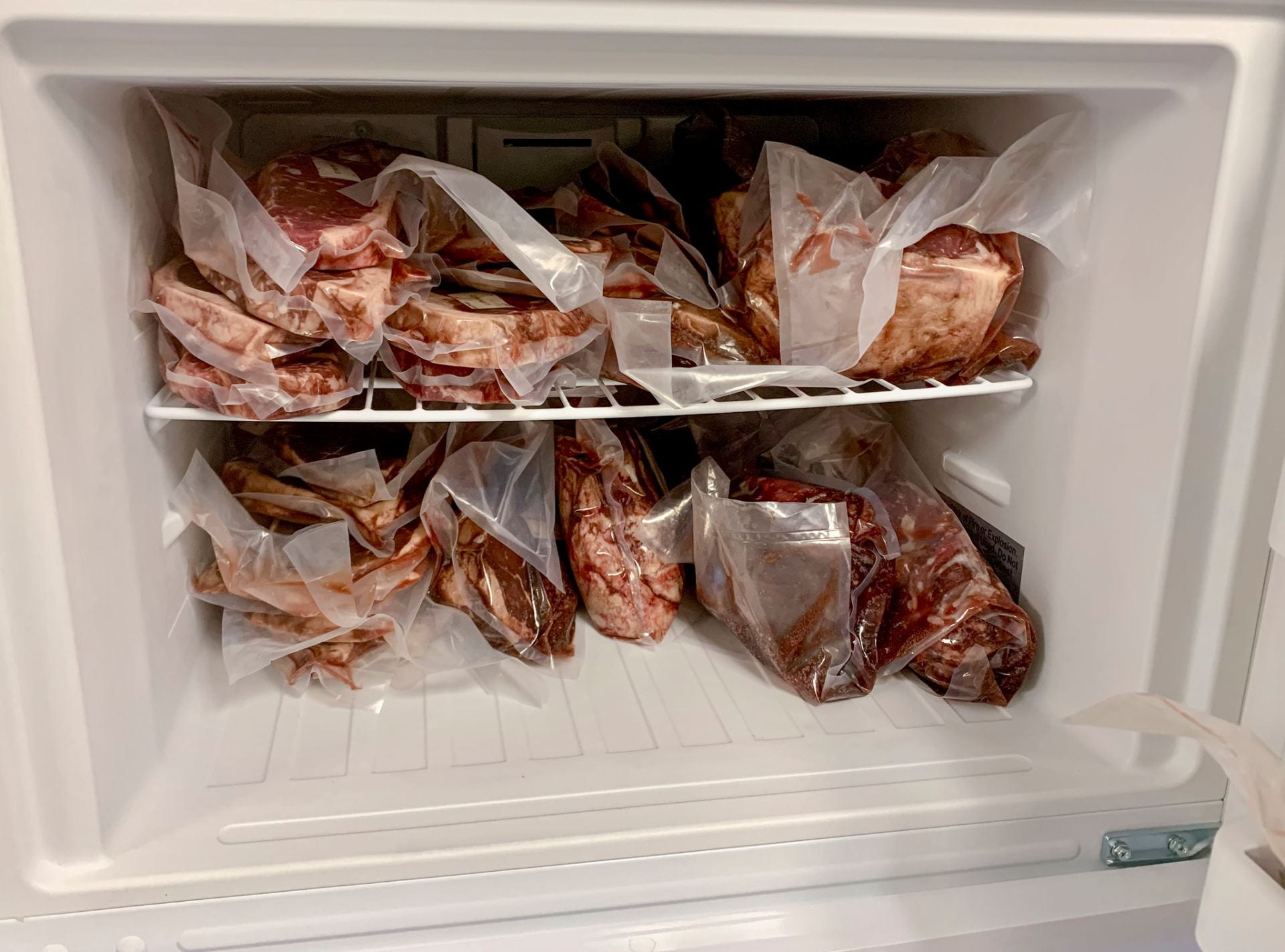
How Long Does a Half Cow Last in the Freezer
Vacuum-sealed beef from Rural Valley Farms has a significantly longer freezer life than store-bought beef wrapped in standard packaging. The vacuum seal removes air from around the meat, which is the primary cause of freezer burn and flavor degradation over time.
| Cut Type | Peak Quality Window | Safe to Eat Until | Notes |
|---|---|---|---|
| Steaks (Ribeye, Strip, Sirloin) | Up to 12 months | Up to 18 months | Best flavor within first year |
| Roasts (Chuck, Arm, Rump) | Up to 12 months | Up to 18 months | Low surface area, holds well |
| Brisket | Up to 12 months | Up to 18 months | Vacuum seal especially important |
| Ground Beef | 4 to 6 months | Up to 12 months | Use first, store on top |
| Short Ribs and Bones | Up to 12 months | Up to 18 months | High fat content, seal quality matters |
Most important rule: Keep your freezer at a stable 0 degrees Fahrenheit at all times. Temperature fluctuations caused by frequent opening, power interruptions, or an overfull freezer that restricts airflow are the most common causes of premature freezer burn. A chest freezer thermometer costs under $15 and is worth having.
Common Freezer Mistakes First-Time Bulk Beef Buyers Make
After years of selling half and whole cow shares to Pennsylvania families, we have seen the same avoidable freezer mistakes come up again and again. Knowing them ahead of time makes your first bulk purchase significantly smoother.
- Buying the freezer the same day as pickup. You need the freezer running and at temperature before your beef arrives. Buy it at least two to three days in advance.
- Using a refrigerator freezer. Even a large side-by-side model holds only 3 to 5 cubic feet. A half cow needs 7 to 9 cubic feet minimum.
- Overfilling the freezer. Packing a chest freezer completely full restricts airflow around the compressor and reduces efficiency. Leave 10 to 15 percent of the space free.
- Not labeling packages with the date. All packages are labeled by cut, but without a date you have no way of knowing what to prioritize or when something is approaching the end of its quality window.
- Running your freezer to 0 degrees before pickup, organizing by cut on arrival, and pulling from ground beef first makes the whole experience completely effortless.
One more thing: If you are buying a half cow for the first time and want to understand the full pricing and what you receive, see our complete half cow cost guide. It covers hanging weight, packaged yield, cut options, and how to reserve your 2026 slot with a $250 deposit.
Frequently Asked Questions
The freezer questions we hear most often from Pennsylvania families before their first bulk beef purchase.
Got Your Freezer Sorted? Reserve Your Half Cow Today
$6/lb hanging weight, all processing included. A $250 deposit holds your 2026 slot at Rural Valley Farms, Butler County PA.
(724) 809-7802 Monday through Saturday, 8am to 6pm Eastern Call to Reserve Your 2026 Slot