Every Pennsylvania family that has switched from grocery store beef to buying in bulk from a farm says the same thing: they wish they had done it sooner. But the decision takes confidence in the numbers. This guide gives you the exact comparison including what farm-direct bulk beef actually costs versus what you are paying at the grocery store, so you can decide for yourself.
Key Takeaways
- Farm-direct bulk beef from Rural Valley Farms is priced at $6 per pound hanging weight , all processing included, no add-ons
- Your true blended cost across all packaged cuts works out to roughly $10 per pound , covering ribeyes, roasts, ground beef, and ribs under one price
- Grass-fed ribeye at Pittsburgh-area grocery stores runs $22 to $28 per pound . Ground beef starts at $9 to $12 per pound
- A family of four buying one half cow per year spends roughly $2,520 compared to $3,200 to $3,800 buying equivalent quality at retail
- The quality difference is real . Pasture-raised beef from a single traceable farm tastes and eats differently than blended grocery store product
The Real Problem With Grocery Store Beef Pricing
Grocery store beef pricing is deliberately confusing. A pack of ground beef is priced to look affordable. The ribeyes next to it are priced per pound in a way that feels comparable. But when you add up everything a typical family of four buys across a month , including ground beef for weeknight dinners, a chuck roast for the slow cooker, a couple of steaks for the weekend, the monthly total is consistently higher than most people realize.
The second problem is quality inconsistency. Ground beef at a major grocery chain is typically a blend of trimmings from dozens or hundreds of animals, sourced across multiple facilities and sometimes multiple countries. When you buy a half cow from Rural Valley Farms, you are buying one animal from one farm in Butler County, Pennsylvania. The traceability is complete and the quality is consistent every single time.
The third problem is the label. "Natural," "hormone-free," and even "grass-fed" on a grocery store package do not always mean what you think they mean. USDA definitions for these terms have loopholes. A grass-fed label, for example, does not legally prohibit grain finishing; it only requires that grass was part of the diet at some point. At Rural Valley Farms, our cattle are pasture-raised and grass-fed their entire lives, with no grain finishing, no hormones, and no routine antibiotics.

Cut by Cut: Farm Direct vs Grocery Store Prices in 2026
The most straightforward way to understand the savings is to compare individual cut prices. The table below uses 2026 retail prices from major Pittsburgh-area grocery chains for comparable quality grass-fed beef, set against what those same cuts cost per pound when purchased as part of a half cow share from Rural Valley Farms at our flat $6 per pound hanging weight rate.
| Cut | Grocery Store (Grass-Fed) | Rural Valley Farms Bulk | You Save Per Pound |
|---|---|---|---|
| Ribeye Steak | $22–$28/lb | ~$10/lb blended | $12–$18/lb |
| NY Strip Steak | $18–$24/lb | ~$10/lb blended | $8–$14/lb |
| Chuck Roast | $9–$13/lb | ~$10/lb blended | Break even to save |
| Brisket | $10–$16/lb | ~$10/lb blended | Up to $6/lb |
| Ground Beef (80/20) | $9–$12/lb | ~$10/lb blended | Break even to save |
| Short Ribs | $11–$16/lb | ~$10/lb blended | Up to $6/lb |
| Flank Steak | $14–$18/lb | ~$10/lb blended | $4–$8/lb |
How the blended cost works: When you buy a half cow, you pay $6 per pound hanging weight for the entire animal , not per cut. At a 60% yield, 420 lbs hanging weight returns ~250 lbs of packaged beef at a total cost of ~$2,520. Divide that across all cuts and your blended average is roughly $10/lb. You are getting ribeye steaks and chuck roasts at the same per-pound cost and that is where the real savings come from on premium cuts.
Annual Cost: What a Family of Four Actually Spends
The individual cut comparison makes the value clear. But the annual picture is where the savings really land. Below is a realistic annual cost comparison for a family of four eating approximately 20 pounds of beef per month , a fairly typical number for a household that cooks beef three or four nights per week.
| Scenario | Monthly Beef Spend | Annual Total | Quality / Source |
|---|---|---|---|
| Grocery Store: Conventional Mixed sourcing, standard quality |
$160–$220 | $1,920–$2,640 | Unknown origin, feedlot-raised |
| Grocery Store: Grass-Fed Premium Labeled grass-fed, various brands |
$270–$340 | $3,240–$4,080 | Variable, labeling not always transparent |
| Rural Valley Farms: Half Cow One farm, full traceability |
~$210/mo equivalent | ~$2,520/year | Pasture-raised, Butler County PA |
The comparison against conventional grocery store beef is close on price but dramatically different on quality. The comparison against premium grass-fed grocery store beef is where the savings become substantial: switching to a Rural Valley Farms half cow saves a family of four $720 to $1,560 per year while actually upgrading the traceability and farming standards of their beef. For a full breakdown of exactly what a half cow costs and how the pricing works, see our complete half cow pricing guide.
"We were spending $280 to $300 a month on grass-fed beef at the store. We bought a half cow from Rural Valley Farms last spring and the quality was better than anything we ever bought at Whole Foods and we paid significantly less for the year. We have already booked our 2026 slot." Customer family, Cranberry Township, PA
2026 Slots Are Filling Up Fast
Reserve your half cow with a $250 deposit. $6/lb hanging weight, all processing included.
Hidden Costs of Grocery Store Beef Most People Overlook
The sticker price on a grocery store package is not the full story. There are several costs baked into retail beef pricing that bulk farm-direct buyers simply do not pay.
The Retail Markup Chain
By the time beef reaches a grocery store shelf, it has passed through a rancher, a feedlot operator, a packing plant, a distributor, and a retailer. Every link in that chain takes a margin. When you buy direct from Rural Valley Farms, you eliminate all of those middlemen. You pay the farm, and that is it.
- Feedlot operator margin added to base cattle price
- Large-scale packing plant processing fee, not transparent to consumer
- National or regional distributor markup, typically 15 to 25 percent
- Grocery store retail margin, typically 20 to 35 percent on meat
- Packaging, labeling, and shrink loss costs passed to consumer
- Rural Valley Farms: you pay the farm directly, one price, full transparency
The Cost of Frequent Small Purchases
There is also a behavioral cost to grocery store shopping that rarely gets counted. Families who buy beef retail visit the store multiple times per week. Every trip involves decisions, price comparisons, and the quiet frustration of watching per-pound prices climb. Buying a half cow once per year eliminates all of that friction. Your freezer is stocked. The decision is already made. You cook what you have, and it is consistently good.
Why the Quality Difference Matters as Much as the Price
Cost savings are the primary reason most families switch to bulk farm-direct beef. But almost every family that makes the switch tells us the quality difference surprised them more than the savings did.
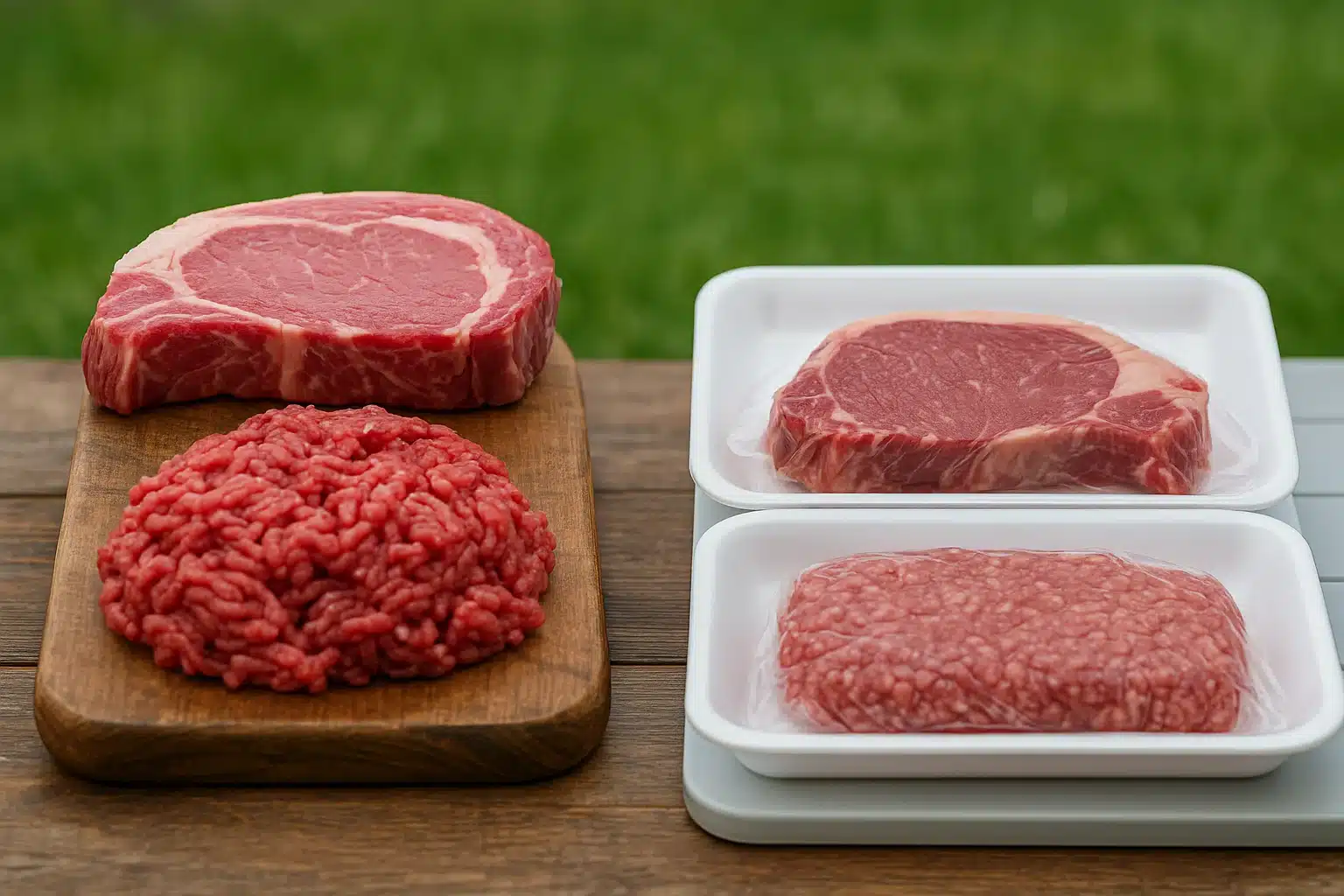
Pasture-raised beef from a single farm has a flavor profile that grain-finished feedlot beef simply does not match. The fat is distributed differently. The color of the meat is deeper. The texture has more integrity, it holds together better during cooking and does not release excess liquid into the pan the way cheaper beef often does. Ground beef made from our cattle forms better patties and holds more flavor when cooked.
Beyond taste, the nutritional profile is measurably different. Grass-fed and grass-finished beef contains significantly more omega-3 fatty acids, more conjugated linoleic acid (CLA), and higher levels of vitamins E and A than conventional grain-finished beef. These are not marketing claims; they are documented differences in the scientific literature on pasture-raised livestock.
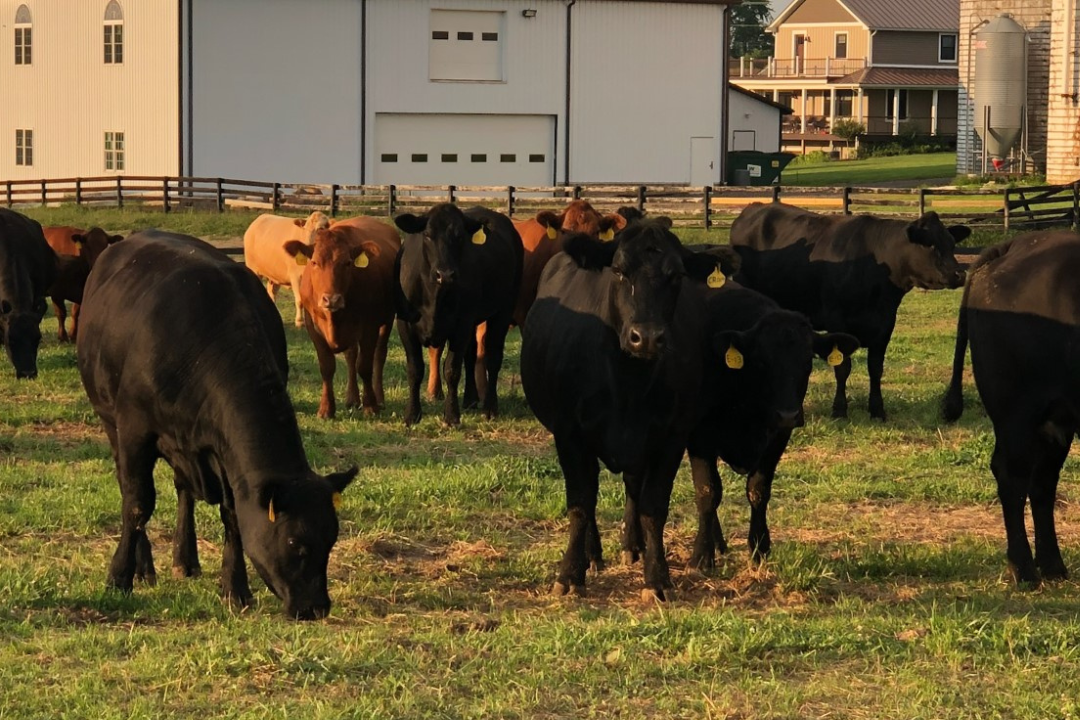
One farm, one animal, full traceability. When you buy a half cow from Rural Valley Farms, you know the animal was raised on our Butler County pasture from birth. You know it ate grass its entire life. You know no hormones or routine antibiotics were used. That level of transparency does not exist in any grocery store supply chain.
Who Bulk Beef Makes Sense For and Who It Does Not
Buying in bulk is not the right fit for every household, and we would rather be honest about that than oversell it. Here is a straightforward breakdown.
Bulk beef is a strong fit if:
- Your household eats beef three or more times per week. A half cow provides roughly 10 to 14 months of beef for a family of four
- You have or are willing to purchase a chest freezer. A 7 to 9 cubic foot model costs $180 to $280 and pays for itself in the first year
- You can handle the upfront payment of roughly $2,520 for a half cow, even if it means planning a few months ahead
- You care about knowing where your food comes from and want full transparency on farming practices
- You want to lock in your price for the year and stop watching beef prices fluctuate at the store week to week
Bulk beef is less ideal if:
- Your household eats beef only once or twice a week. A half cow would take too long to work through and freezer quality degrades past 18 months
- You cannot accommodate a chest freezer in your home. A refrigerator freezer alone is not sufficient for a half cow
- You need maximum flexibility in cut selection week to week and rarely repeat the same meals
For households in the first group, the majority of Pennsylvania families we speak with, the case for buying bulk is very strong on both price and quality grounds.
How to Get Started With Rural Valley Farms
Starting is simpler than most people expect. There is no online form, no complicated signup, and no commitment beyond a single phone call. We keep the process direct because farming is our business, not e-commerce.
- Step 1: Call (724) 809-7802. Ask about 2026 availability and which purchase sizes are still open. Our team will walk you through the options without pressure.
- Step 2: Choose quarter, half, or whole. Most first-time buyers choose a half cow. It is the best balance between upfront cost, variety of cuts, and freezer space required.
- Step 3: Pay your $250 deposit. This holds your processing slot and applies toward your $2,520 total balance. No slot is confirmed without a deposit.
- Step 4: Fill out your cut sheet. We send this 4 to 6 weeks before your processing date. Specify your steak thickness, bone-in preferences, ground beef ratio, and more. We help first-time buyers through this step every day.
- Step 5: Pick up your beef. Vacuum-sealed, labeled, and ready for your freezer within 10 to 14 days of your processing date. Pay the remaining balance at pickup.
Book early: Spring and summer 2026 processing dates at Rural Valley Farms typically sell out several months in advance. If you are considering this for the first time, the right moment to call is now, not when your current supply runs low. Call (724) 809-7802, Monday through Saturday, 8am to 6pm Eastern.
Frequently Asked Questions
Straightforward answers to the questions Pennsylvania families ask us most before making their first bulk beef purchase.
Stop Overpaying at the Grocery Store
$6/lb hanging weight. All processing included. One call is all it takes to lock in your 2026 slot with a $250 deposit.
(724) 809-7802 Monday through Saturday, 8am to 6pm Eastern Call to Reserve Your 2026 Slot